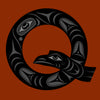
Headdress depicting Tlingit Style Mosquito, c. 1990
Duane Pasco (1932-2024)
red cedar, abalone inlay, leather, feathers, wolf ruff, pigment
8” high x 11” long x 7” wide
Duane Pasco was born in Seattle, Washington in 1932. As an infant, Duane moved with his parents to Anchorage, Alaska. Duane grew up near the mouth of Ship Creek, and watched the Dena’ina People set up camp in the late summer to catch and cure salmon for their winter food supply. When the first snow fell, they departed by sleds and dog teams for their trap lines. In mid-winter they returned for the fur rendezvous to sell their catch. Recollections of these occasions left a very strong impression, and thus began his life long interest in Native American art and cultures.
Duane’s Alaska experience led him to expand his interest in Native American and First Nation cultures, reading all that was available in the school and public libraries. As an adult, his focus began to turn specifically to the Northwest Coast cultures. Duane began carving as a hobby in 1959 and carved curios sporadically until 1967.
Frustrated earning a living as a carpenter and structural ironworker, he turned his passion for Native art into a career. This allowed him the time to research and develop the skills necessary to understand and practice the art form he loved. This placed him at the forefront of what is often referred to as the “Renaissance” of Northwest Coast Indian Art.
Duane was a consummate student and for the most part a self-taught artist, although he acknowledges the influence of the publication “an Analysis of Form” by Bill Holm and the work of nineteenth century Native artists in museums and private collections. From this beginning, Duane focused on the traditional, striving for authenticity and has become a scholar of Northwest Coast Native art and culture. He has a solid base in all the regional art traditions of the Northwest Coast, but has developed a style within a style, as it were, and his work is easily recognized.
As an active teacher from the outset, Duane taught and lectured continuously in Alaska, British Columbia and the United States. He believed strongly in the perpetuation of the great art form, and many of today’s prominent artists in the medium have benefited from his tutelage including Tsimshian master carver David A. Boxley and the Gitxsan carvers of the ‘Ksan Village Project in British Columbia.
Duane innovated within the Northwest Coast Native tradition, and experimented with free-form sculpture, as evidenced in some of his later creations. He derived inspiration from experiences on the forest and mountain trails of the Olympic Peninsula, plying the waters of Washington and British Columbia in his Haida canoe, and in the wooded environs around his home and studio.
His works are in the collections of the Museum of Fine Arts, Boston MA; University of British Columbia Museum of Anthropology, the Gustav Heye Foundation Museum of the American Indian; the Burke Museum of Natural History and Culture, University of Washington; Alaska State Museum, Juneau, AK; Weyerhauser Corporation, Seattle, WA; Bank of California, Seattle, WA; Eastman Kodak Corporation, Bellevue, WA; Safeco Corporation, Seattle, WA; as well as in many private collections.
Three of Duan’s totem poles grace Seattle’s Pioneer Square Occidental Park.
Duane Pasco died July 31, 2024, at his home in Poulsbo, Washington.